

Trust at the Table | Mastery
Encouraging bold play

The moment is coming.
I avoid it as best I can. I bend the fabric of my world to keep it from happening. But sometimes nothing can stop the debt from coming due. It is the moment that all DMs dread.
I’m about to have to roleplay three NPCs having a conversation with each other.
Sometimes there’s nothing else for it. One of my players has sidled into a bar looking to eavesdrop, I’ve given them the summary version of what they heard, and they’ve asked to hear what was actually said. A reasonable request. It’s just that now I need to roleplay the bickering I already described.
Except, I don’t need to. The moment doesn’t come. One of my players rescues me.
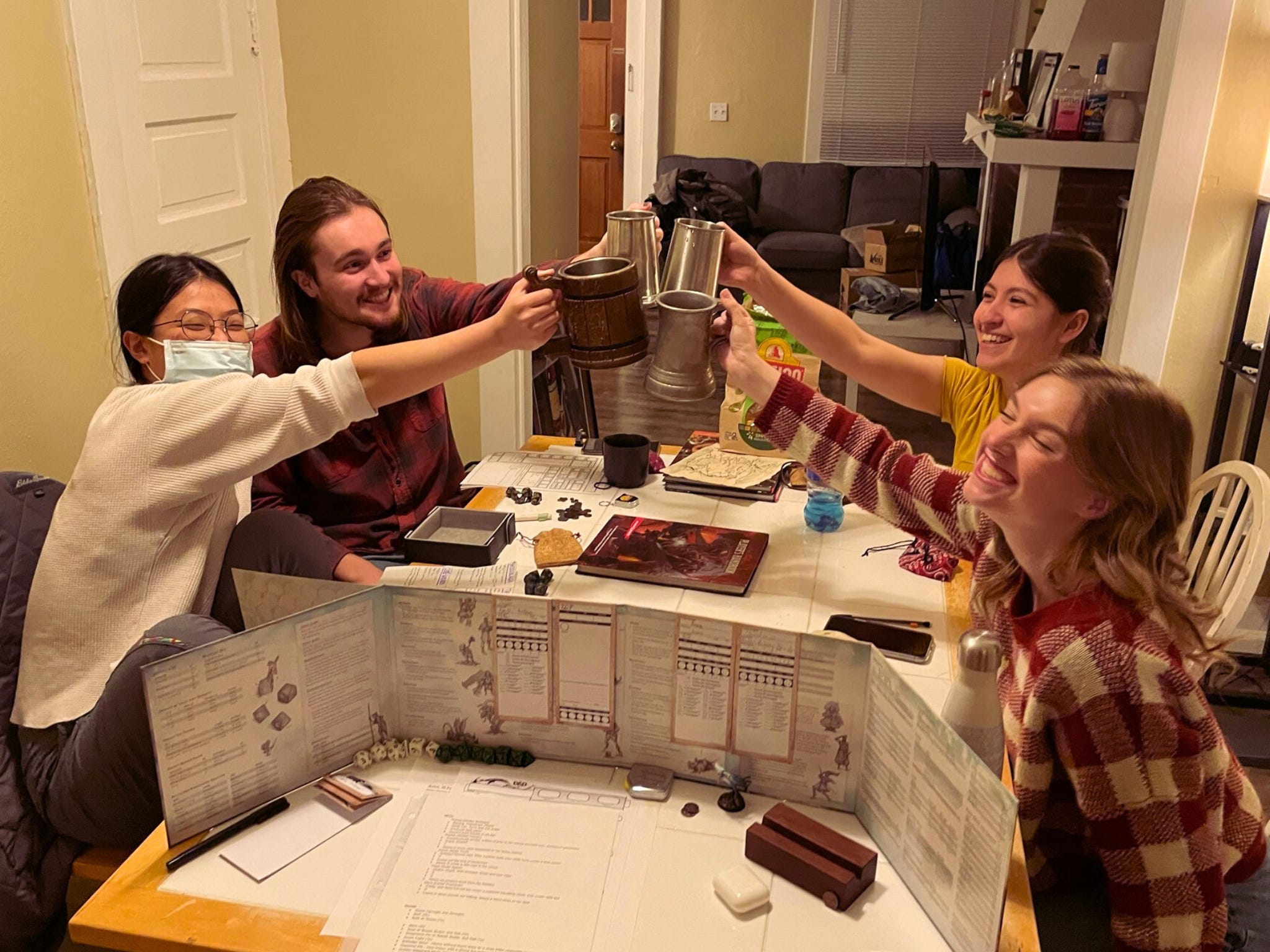
This article is about why your players are the coolest people in the world, why you should trust their bold decisions, and how you can cultivate a table where players make bold decisions. It’s also about how the players in my games have made me feel like the most spoiled GM in the whole damn world. So keep reading to hear some fun stories from the games I’ve run lately and for some advice on encouraging bold play at your table.
Enter Babushka, stage left
Let’s get back to our story! To recap: the New Saints are scattered all around the city of Oakhurst. Mandy, our Barbarian, is loitering in a bar trying to get a feel for how the locals regard the Silver Company (an enemy faction).
A few old folks are bickering about the local Company garrison, and Mandy is listening in. These old-timers are the three NPCs I’m about to have to play.
NPC Conversations
I’m playing up my dread about this situation a little, but the whole multi-NPC-conversation thing is genuinely one of my chief fears as a Dungeon Master.
It’s my job to create a dramatic and interactive world. Two NPCs talking to each other can be important. It can sometimes set up interesting, interactive moments. But it is not interactive. It’s basically never interesting either. The patent odd-ness of performing two characters in conversation means there’s no way to get dramatic or comedic timing right, and the character voices can hardly help but get muddled.
So I’m sweating, trying to harden my alar and split my mind into three parts, all while knowing that the best case scenario for this scene is that it turns out basically fine. Even if this works, it isn’t going to be an excellent moment.
I spit out my first line about how “the Silver Company are heroes of the people,” and start readying up the next NPC’s response when somebody else answers me. Across the table, Nathan has wrapped a blanket over his head, tied it with a babushka’s tuck, and started bickering back at me.
So I retaliate. Instead of an awkward solo performance, now it’s a scene. Both Nathan and I bring new characters into the argument until it sprawls out into the whole of the bar. We’re able to do that because – as many characters as are introduced – we’re always able to talk to each other and not to ourselves. It turned something that I was dreading into one of my favorite moments of that campaign.
So how did this happen?
I’ve never had anything like it happen in a game of Dungeons & Dragons before. That’s not too surprising, because that’s not really the kind of game that D&D is. This shared storytelling responsibility is more common in other systems, but Dungeons & Dragons has a very explicit divide between the realm of the Player and the realm of the Dungeon Master. Players don’t create NPCs in D&D.
Except Nathan did, and it worked out fantastically. Frankly, that’s a big deal.
I run tabletop roleplaying games because I love what happens when my ideas collide with the ideas of players; the point at which the art is experienced is brought into coincidence with the point at which the art is made, and that is one of the spectacular magics of our medium. For that to happen, though, players need to bring their ideas into the game. They need to make dramatic choices and do unexpected things, and that kind of action necessarily comes with a certain risk. The decisions with the most potential for drama are the ones that break (at least a little) from what is expected.
So if this excellent decision was so far outside the bounds of expected play, why did Nathan make it?
“I was possessed by the Babushka energy,” was his very funny and very unhelpful first answer to that question.
Hot Babushka Tip
If you want to capture the Babushka energy, I’d try keeping your playing space very cold and very full of blankets. Then play long enough that everyone gets sleepy.
We talked more though, and what we came upon was this: Nathan was confident he could intercede successfully, and he was confident I could react to it. I want to run games where players feel able to bring their unusual ideas to the table. That means it’s my job to give my players a foundation for this kind of confidence.
How do we do that?
That foundation for decision-making is context, and the tools we use to strengthen that foundation are consistency and legibility.
Today, context is what your players know about the decision space that they’re in. What got them to this point, and what will change as a result of their decision? The better our players understand this information, the more agentfully they will be able to make decisions.
Legibility is how clearly our game communicates a given piece of information. Consistency is whether we’re communicating the same information every time.
When players act, there are consequences. If we’re being legible, players can draw a line between decisions and their consequences. Consciously or not, that line is data for their future decisions. Across many decisions and consequences, a consistently run game will develop its own set of internal rules and logics. Understanding these is what gives our players the context in which to make decisions.
So far, so agency in game design. Here’s where I’m going to make a slightly bolder take: I think that there are essentially three important contexts for decisions at the tabletop. These are the narrative, the mechanical, and the social.
The Narrative Context
If a player is going to make a bold decision that has some impact on the story, there can be a risk that their decision will somehow break the story. They don’t want to stop the narrative from making sense, they don’t want to make the story boring, and they don’t want to stumble into unforeseen consequences for their characters.
These anxieties come from an uncertainty about how the gameworld will react to a given decision. We reduce that anxiety by creating a consistent and legible world, which gives our players narrative context.
Keep the tone of your game steady so players can find the game’s voice and style. Let its main ideas show up often. Show the consequences of player actions in obvious ways. Make those consequences internally consistent. Let your players learn the rules of this world and story.
If players are uncertain what the outcome of an action will be in the moment, it’s often best to just tell them. If a player asks what will happen if they do X, don’t tell them “Try it and find out,” tell them “Probably Y, but Z might happen if it goes badly.” Give them the information they need to make informed decisions.
If they do something expecting an outcome that you don’t think is most plausible, sometimes it’s best to adjudicate in their favor. Let the world react to them in the way they expect it to, and this will reinforce to them that they are equipped to make informed decisions.
In Practice
That’s all very high-level. Lets look at what it meant for the scene we’ve been talking about. What context did Nathan need to understand in order to jump into this scene?
He needed to understand what this scene was. As a piece of a story, this moment needed to establish that locals had conflicting attitudes towards the Company and it needed to give specific ideas of what those attitudes are.
He needed to understand these NPCs. This was an argument about the Silver Company, and that means Nathan needed to have an an idea what ordinary people thought of the Silver Company before he could intercede. The Company were important players in this game, and their relationship with the populace was an important social tension in this game. This was a part of my game that I wanted players to be able to interact with, so I had spent the game demonstrating that relationship legibily and consistently.
The Mechanical Context
If a player is going to make a bold decision that interacts with game mechanics (and this is most decisions in a TTRPG), there is a risk that their decision will either conflict with the rules or create mechanical penalties for their character. If this risk is not clear to the player, it can discourage them from taking action.
To understand what concrete, quantifiable impact their decisions will have on the game, players need to know what kinds of concrete, quantifiable consequences you enact at your table. When do you dole out damage and when do you grant exhaustion? For what do you award XP? For what do you award inspiration?
As always, we want to be consistent and legible. Teach players the mechanics of the system you’re playing in. Enforce those mechanics consistently. That doesn’t need to mean consistently with the rules as written, but it does mean consistently with your other rulings at the table.
Another component of this is making it clear when you are willing to adjust the rules of the game to better resolve a situation. If a player has a plausible action they’d like to take in combat, but that action is not mechanically supported, will you allow that? Communicating this information reduces the kind of ambiguity that could stop a player from doing something exciting.
In Practice
A different story this time. Having escaped the Silver Company in Oakhurst, the New Saints fled across the countryside towards the Crossroads. I ran this using my Journey System.
Early on in this Journey, Zoe failed an important skill check. They narrated this as being the result of an untreated wound that they had gained in a recent, near-fatal combat. Rowan had hidden this wound from the party, and now they all had to reckon with that. When Zoe failed another skill check, they took the opportunity to narrate the wound festering and overcoming Rowan. The Journey warped around this decision in an incredible way; the entire challenge became about protecting, caring for, and treating the wounded Rowan. The obstacles were different, the solutions were different, and the stakes were different.
What was the context that Zoe needed in order to create this great peril for their character? Well, Zoe needed to know that I wasn’t going to kill their character. By creating a mortal danger to their character, Zoe was risking that I would follow through and kill Rowan if the skill challenge went poorly. But that’s not how the Journey System works. It’s not there to kill PCs. It’s there to delay and to exhaust a party. Zoe knew that. Within this framework, they were free to present mortal threats knowing that their consequences would – in this mechanical context – be less than mortal.
The Social Context
The last kind of uncertainty we need to address is social. When a player makes an unusual choice, they risk that choice being rejected by you or the other players at the table. As a DM and as a table of players with culture and tradition, you need to communicate legibly and consistently how your table feels about unusual decisions.
Do your players trust that you as a DM will be comfortable and happy adapting to your decisions, and do they trust that you will tell them “no” if not? Your players need to be able to trust that you will give them grace and space to experiment and that you will communicate your discomfort respectfully if you’re 100% not on board with what’s going on. Have out-of-game conversations about your table’s culture, use safety tools, and try your best to keep a consistent attitude toward weird stuff.
Perhaps most importantly, introduce your own bold ideas. As the person with the most authority over the game, it is easier for you to make unusual choices than it is for your players. Doing it yourself establishes a precedent for your players to do so, and it gives everyone an opportunity to see how the table as a whole reacts to the unexpected.
In Practice
This was an important context for Nathan during the Babushka Moment – this is what he was talking about when he said he “trusted me to react to it.”
Because this decision was outside of what D&D usually looks like, he needed to know that the table (and me in particular) wouldn’t get grumpy at him or feel like he was stepping on the DMs toes. Because we had run a game that included some non-traditional storytelling toold (cut-away cutscenes) and a high degree of player direction, this felt like a safer choice. Because I had consistently communicated my needs and feelings about the game (and run the game confidently and authoritatively) Nathan trusted that I would put a stop to the shenanigans if I thought they were taking us off the rails.
What This Gets Us
Now none of this is going to guarantee that you’ll have players jumping in to play your NPCs. Frankly, I think a lot of you wouldn’t like that. It’s also not to say that you’ll have players volunteering their characters to be maimed like in our story about Rowan. Those were my players, and those were their bold choices. Nathan is an improv performer; creating characters spontaneously is something that he is uniquely confident doing. Zoe is a grim sort of person and wholly dedicated to telling a dramatic story.
What this does guarantee is that your players have the chance to make their own bold choices to the table. Every player who sits down to play with you brings their own experience of the world, their own skills, and their own ideas. Our medium makes meaning by putting those perspectives into conversation with each other as mediated by the systems and content of our games. To run a meaningful game means making space for your players’ perspectives, and we start that by building a creative environment that minimizes the courage necessary to get involved.
You’re playing with people that you like and that you think are interesting, and your game will be richer for those interesting people feeling more free to bring themselves to your game.
Wrapup
I think that this is the third article I ever started writing for Substack, and I’ve never not tinkered with it between articles. Something about it just trips me up and tangles in my brain. I have it on good authority that it’s finally coherent, but I’m still a little nervous that it’s a secret mess. You’ll all have to let me know.
Apart from this article taking forever, it’s taken forever for me to get anything out; I’m grateful to you for sticking around while my page has gone dark. It’s been a weird couple of months. I’ve had lots of changes to my personal life that have made writing really difficult, but I’ve also managed to work on some exciting new stuff that I’m ready to show you. I’ve got an update post slated for Monday, and that’ll give you a good idea of what to expect from me in the near future! I’m really excited about it, y’all.
Okay, that’s all for now. Take a deep breath. Give someone a hug. Go play a new game. Love and power to you all.

This article featured a picture of the New Saints party taken by me.
Sparkman you bastard you did it again. Stop writing such good articles, it makes me miss playing >:( (and also reminds me how much I love comms, dear god-- the way I sat up at the word "context" is frankly embarrassing)