

Making Money Matter | Mastery
And finding mundane drama

Winter hung heavy on the horizon, and the New Saints were hungry. They hadn’t expected the trouble in Redfen. They hadn’t planned on slipping away before the blood on the tavern floor had time to dry. But like it or not, they were a part of something bigger now. And they were hungry.
Being heroes didn’t pay well, at least it hadn’t so far. Food, equipment, and lodgings – each had emptied their pockets one penny at a time. Now they found themselves in the alleys of an unfamiliar city with no one to turn to for help. Well, almost no one.
That’s a story from my last big D&D campaign, and – if you can’t tell – I can be a bit of a bastard about money in my games. It probably comes from the fantasy that I like to read. The Kingkiller Chronicles were foundational to me, and I love the way that Rothfuss keeps you aware at all times of how much money is in Kvothe’s pocket. To be very transparent, I’m also sure that it has bled into my fiction from my own life. I’ve always had to be worried about money. It’s important to me, and that means it’s important to the stories that I tell.
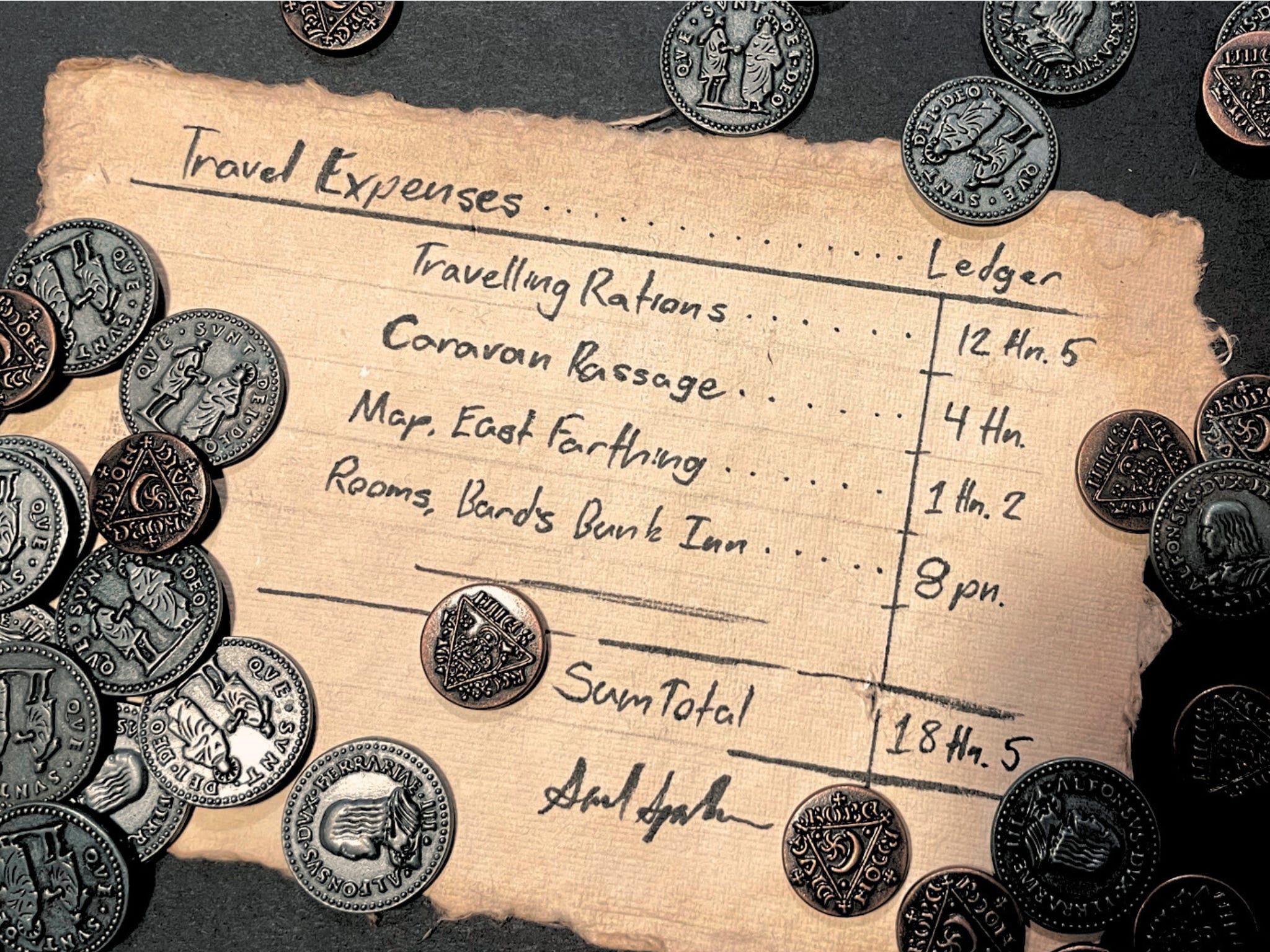
This post is about knowing when and how to make money important to your campaign. By default, Dungeons & Dragons is not a game particularly concerned with mundane struggles, and incorporating these elements effectively can be super tricky. I’ve run for a while with a close focus on player wealth, and the following is my advice for making it work in your game.
Why draw attention to money?
When I ran my “New Saints” campaign, I decided I wanted to make money matter. I did that because I thought it would make the story that we were telling better.
The characters that my players brought to the table were all outcasts and wanderers, people who did not match what their societies expected of them. They were people whose existence as themselves was threatened by the world they found themselves in. Wealth became a tool with which we could highlight that in our campaign. That tool created some of the most interesting, memorable, and original moments of our game.
Pepper sits alone and still in the undercroft of St. Brandon’s Cathedral. Their candle burns low, and their quill sits forgotten. Before them lies a letter. Long-finished. A letter to their father.
All they have to do is sign it. To seal it and send it. They would never lack for wealth again. They would never starve again.
The dying candle flickers, and Pepper blinks their reverie away. Their eyes move from the candle to the parchment and back again. Their jaw stiffens. They lift the letter to the flame and watch it burn, watch it burn until there is no light left at all.
Towards the end of one of our early sessions, our artificer was writing a letter home. Pepper came from wealth and from power, and they knew that if they contacted their father’s organization, they were likely to receive support that would make the party’s poverty a thing of the past. But a foundation of Pepper’s character was the rejection of their family’s control. Nathan (Pepper’s player) knew that this letter home would compromise everything that their character held dear, and ey still considered it.
This moment captured beautifully the drama of choosing to separate yourself from power and privilege, and it could never have been as poignant if the party had not felt genuinely restricted by their lack of funds.
Pepper chose not to send the letter, and the party’s subsequent plan to con their way into wealth became one of the highlights of that campaign. “The Vanilla Plot” comes up more in conversation than basically any other arc of that campaign.
When I started my Silver Company game a couple of months ago, however, I chose to place almost no focus on money. No prop coins, no paying for rations, no haggling. It isn’t important to the stories of those characters, and trying to make it important in that game would split our focus and create dissonance.
Not every campaign will get better if you make money important. But if your campaign aims to focus on the struggles of mundane people, to make navigating the everyday world a challenge, or to highlight means of subjugation besides direct violence, your game will be improved by thoughtfully engaging with your players’ coin. If that sounds like your game, the rest of this article is for you.
Setting tweaks
So here’s the easiest first step to take: ditch gold as your baseline currency. Setting aside it being ahistoric, gold feels too valuable. We live in a culture that has spent most of history reifying the stuff as the signpost of wealth, and if your players have a pocket full of it, they will not feel as if they are struggling even when they are.
So we’re going to use silver as our standard. Whenever you read a value in gold, just convert it directly to silver. Loot of 3 gold and 5 silver is now loot of 3 silver and 5 copper. A candle worth 2 copper can now be bought with even less valuable iron coins.
Just this will very quickly ground the feeling of money in your game, but I like to make a couple more tweaks to take this further.
The first is to change the conversion rates of your coins - instead of converting at an even 10 copper to 1 silver, 10 silver to 1 gold, etc. choose a few to make weird.
Setting Note: Coins of Ordinheim
Gold Ransom, 10 Golden Staves
Gold Stave, 50 Silver Talents
Silver Talent, 10 Copper Pennies
Copper Penny, 5 Iron Bits
I find that this little bit of inconsistency works wonders for verisimilitude, and the amplified value of gold serves to highlight the players’ relative lack of wealth (it also makes finding gold a spectacular moment).
While you're at it, give your coins names. Mine are above , but you can come up with your own or just borrow the coins from your favorite fantasy fiction.
Making players struggle
Now it’s time to make those coins matter; it’s all well and good to know that twenty-four talents are nearly half a stave, but until knowing that helps players to overcome obstacles, it won’t matter. The game isn’t about your world, the game is about what your players choose to do in it. So make their money (or lack thereof) impact their choices.
The start of this is the obvious and the familiar: food costs money, and so does having a place to sleep at night. Traveling to a new place is dangerous if you can’t afford to outfit yourself for it. These are easy knives to turn that will get the party engaging with their money and the everyday realities of their adventure. Brush up on the rules regarding exhaustion so you can inflict penalties on characters not taking care of themselves, and consider using the Travel System that somebody really sexy posted a little while ago.
Think about the expenses people would face living in your setting. Are there tolls on bridges? Taxes to enter a city’s gates? Fees to carry weapons? If the party needs to meet someone important, will they have to pay to dress themselves formally?
Also begin to think about what, if any, resources exist in your setting to help those in need. Do churches offer a place to sleep? Simple meals? How do local communities take care of their own, and how do they react to outsiders in need of help? Should players come to rely on any of these, how can they be threatened?
Making players strive
Don’t end with punishment, though. Even if our goal is to create grounded struggle and mundane drama, our players are still playing Dungeons & Dragons. That means they’re expecting to engage with the game in a heroic way, and they’re going to expect to progress. So feel free to limit the opportunities that they have to gain wealth and to present them with situations that drain their funds, but when the time comes for them to enjoy the fruit of their adventure, let it happen.
Most every D&D adventure is structured to give characters loot and treasure as they succeed, and instead of putting that off forever, make sure that the PCs have things that they want to do with money when they get it. I like to offer the party lots of small upgrades they can get when they have enough money (these mundane weapon upgrades are great for that). I also like to make sure my characters have well-developed personal objectives, and money is often very important for achieving those.
If the time comes that your party no longer occupies a place in the world where they need to be concerned with their wealth, that’s also okay. It is perfectly acceptable to make good on these systems at lower levels and to let that give way to more traditionally heroic drama when they progress. Be conscious of when twisting these knives is dramatic, and when it’s adding slog and friction to your game.
If you do choose to drop the focus on money as your game progresses, be conscious of what that means for the party moving forward. They occupy a different place in society. People will treat them differently. Will these former thieves now be seen as marks by their old friends? Will they be looked on mistrustfully by those who would have sheltered them before?
Prop coins
As long as I am making my players worry about their money, I like to use physical coins at the table. I've talked before about when I like to use props, and I think coins can be an excellent way to bring physicality to the table.
Using coins signals to players that their money will be important, and gets them focused on that area of the game. It lends weight to every transaction and to every coin that a player has. Running low on money is made to feel dramatic by a light purse. Buying drinks at a bar is both grounded and made slightly treacherous by handing over hard-earned coins to do it.
I found that as soon as I gave my players coins, they started trying to haggle and barter when they made their purchases. They rushed to loot every body they encountered (or created), something that my parties had never done before.
As is always the case with props, coins will not singlehandedly shift the vibes of your game. I’ve seen a lot of folks online talking about their prop coins falling flat, and I think it’s because people introduce coins for the physicality without giving weight to money in their games. Without small transactions being important, representing them with physical transactions just adds friction. If you have chosen to give those transactions emphasis in your game, however, coins will be some of the most effective props you’ve ever used.
If you’re looking to do this, I think the best quality for your money comes from The Broken Token’s coins. My set is built up off of a set of Sword & Sorcery board game coins (that I don’t think you can buy at the moment), supplemented with Broken Token stuff overtime as I can afford it. For iron bits, I use metal beads. If you’re getting coins, I’d also recommend getting some little pouches for player coinpurses and for giving new money to players in. Something like this is a great start, but adding unique little bags to your collection over time gives players a way to customize their kit in the same way that they would with dice.
Wrapup
So that’s running a game focused on money! I have had a ton of fun doing it, and I’m really happy with the stories I’ve gotten to tell with my players because of it. Please let me know if you use anything I’ve written here and how it went!
You know, writing this is finally starting to feel like a real thing that I do. I’m really proud to be writing for y’all, and I’m really proud to be consistently doing work. Thank you for sticking around to read it.
This Friday, expect the first of my more casual Correspondences. After that, an article about running mysteries and another about pirates!
The photo in this article was taken by me!